© 2007 Stuart Pearl - Click on Photo to Enlarge
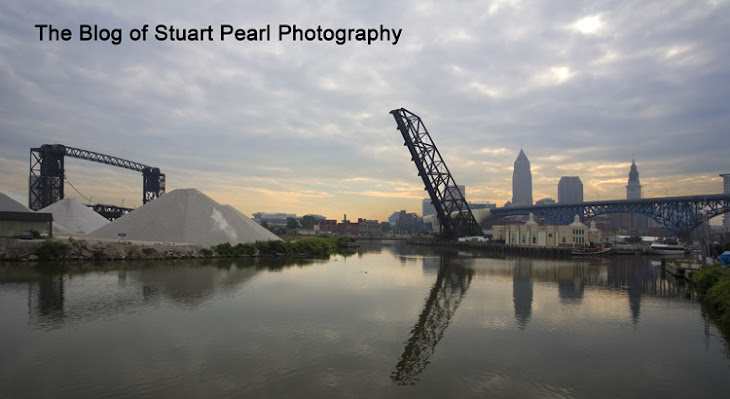
I wonder if Margaret Bourke-White walked the same roads. Perhaps she focused her lens on the same old bridges during her Cleveland years. These are thoughts that I have as I explore the industrial Flats and the riverbanks of the Cuyahoga with camera in hand. For Bourke-White it was all about the interplay of light and shadow among the structures she discovered. The bridges, factories and smokestacks were a fantastic playground for her creative eye. I think I now understand some of what she saw more than 70 years ago.
See more Cleveland photos at: http://www.pbase.com/sapearl/cleveland_flatsMargaret Bourke-White might be surprised by many of the new structures that comprise downtown Cleveland and the Flats today. But I believe she would still recognize those signs of the early steel industry which spread across the Flats last century. Many of these factory and bridge structures still exist today. They remain a testament to what was once a center of thriving industry and steel manufacturing.
Arrival in Cleveland
Bourke-White photographed Cleveland during her short residency here from 1927-1930. Those early images were diverse, covering both the steel industry as well as private residences of the wealthy which were then published in Town and Country Club News. (1)
The industrial pictures focused on ore processing in the old Otis Steel Mills. After extensive experimentation, she was able to create images of the manufacturing process that had never before been published.
I’ve been reading Bourke-White’s excellent autobiography Portrait of Myself.(2) Her book has been somewhat of an inspirational roadmap for my summer project photographing the Flats. She was Fortune Magazine’s first photographer and a forerunner in the field of photojournalism. Her notable images include those of Stalin, Churchill and Ghandi, as well as the Great Depression and WWII. She has the distinction of being the first female accredited war correspondent.
It is Bourke-White's early years in Cleveland that have special meaning for me.

She was enthralled by the massive machine images
of the area's growing industry. Our cameras were attracted to the same industrial subjects.
Bourke-White came to Cleveland in 1927, arriving by overnight ferry from Buffalo.
Margaret wrote in her autobiography:
"I stood on the deck to watch the city come into view. As the skyline took form in the morning mist, I felt I was coming to my promised land...columns of machinery gaining height as we drew toward the pier, derricks swinging like living creatures. Deep inside I knew these were my subjects."The Cleveland shoreline is now quite different from that 1927 view. Some bridges have been demolished while others and have been closed and now point forever skyward. Whiskey Island’s Huelett ore unloaders ceased operation in December of 1992. They were dismantled in 2000. Although steel production has dwindled in the Flats, you can still see remnants of the city’s industrial heritage along the banks of Lake Erie and the Cuyahoga River.
The Artist Moses PearlMany artists and craftsmen have been drawn to the Flats over the past 150 years during its industrial age. From the middle of the last century until just a few years ago, my father Moses Pearl spent many mornings visiting the Flats. He could often be seen standing at his easel with charcoal pencil or paint brush in hand. As an urban landscape artist he captured a variety of those industrial images on both canvas and sketchpad.

Dad would return home after his sketch trips and promptly display the new work in his studio for all of us to view. It was always fascinating for our young family to see which new factory structure, river bend or sweeping bridge arch he had chronicled on canvas. Even though we lived in the suburbs, we were treated to new glimpses of the city almost every week during this period of our lives.
And with this window into a fascinating and unusual environment, it was probably inevitable that I would explore the same crooked streets and factory structures when I grew older.
Medium Format View
My photo trips to the Flats began in 1974. I chose camera and film instead of brush and canvas, and my tool of choice was the medium format twin lens reflex. That summer I bought a used Mamiya C220 TLR which was my first pro level camera. It created a square negative measuring 2 ¼” x 2 ¼”.
Rugged, easy to use, and with simple manual adjustments, it was an inexpensive way to get into medium format photography. It also created an image that was more than three times the size of a 35mm negative. This larger film format made it possible to create highly detailed enlargements with excellent resolution.

During this period I had also started doing part time wedding and social event photography. The Mamiya proved to be a boost to my wedding work which in turn helped to finance my fine art efforts. By using a professional format camera, I was now able to offer images that were superior to those of my competitors who still used 35mm equipment.
EncouragementDad encouraged my pursuit of photography as an art form. To that end he built a modest but functional darkroom in our basement. I developed and printed my first medium format negatives in that small room in our suburban home.
Nearly 50 years earlier, Bourke-White followed a similar passion as she created her iconic images of Cleveland's industry and manufacturing operations. Her darkroom was located in the new Terminal Tower complex. Besides capturing images of steel production in the Otis Mills, she had also documented construction of the Terminal complex for the Van Swearingens. She always matched her tools to the task, shooting large format film for her industrial images. Later as a photojournalist she adopted more compact cameras and smaller film formats.

I professionally shot medium format film for more than three decades. Most of this was wedding and social event photography. In 1998 I upgraded from Mamiya to the Hasselblad equipment, one of the finest medium format SLR systems ever made. The lenses are superb and the camera itself is both ergonomic and extremely reliable. It’s no surprise that Hasselblad accompanied NASA on the moon trips.
Whenever I had spare time I would always return to Flats and the Lake Erie shoreline. Cleveland’s seasonal changes create a variety of lighting conditions that can generate some fascinating images. Family vacations were also an opportunity to photograph the National Parks. I loved doing medium format work in all of these locations.
Transition
Late in 2005 I realized I had to make the switch to digital if I were to continue with event photography. This was a difficult and painful decision. I had always been a film person and was very reluctant to set aside the Hasselblad equipment.
My rationale for changing was both financial and competitive. Lab costs for film processing were spiraling upwards. Many of the pro labs no longer printed directly from film negatives. Commercial labs still processed film in the conventional manner, but then scanned and digitally printed the images. This “middle” step was not only slowing my workflow but it was potentially degrading some of the detail and tonal range of the original film capture. At the same time, my competitors were delivering more pictures to their clients, very extensive coverage, and enhanced finishing services at costs I couldn’t touch with film.

I bought my first digital single lens reflex camera in the spring of 2006. After months of research I decided upon the Canon Camera system and now use 5D in my pro work. I also acquired some wonderful zoom lenses that which simply were not available for my medium format equipment. Coupled with auto-focus and improved exposure technology, I was now in a better position to compete.
Digital View of the FlatsMy transition to digital has offered a variety other benefits. It is now much easier pick up the camera on a whim, experiment, and view the printed results almost instantly. I no longer have to wait several days for UPS to deliver the results from my commercial lab. If the exposure is undesirable, it can be changed and verified on the LCD in a matter of seconds.

All of this has meshed very nicely with my summer project photographing the Cleveland Flats. Just as Bourke-White would always try to match the proper camera to the job, I believe she would have enjoyed the evolution to digital. She loved technological advancement and marveled at the 20th Century's early machines.
She experimented with the latest lighting techniques, films and paper emulsions in order to get her breakthrough Otis Steel Mill shots. And it was those early industrial images which brought her to the attention of Henry Luce, creator of Fortune, Time and Life magazines. I believe the dSLR would have been welcome in her camera bag.
Summer Project
In the summer of 2007 I took the 5D into the flats for the first time. I have never been a morning person, but looking at things photographically my favorite part of the day is prior to 9 A.M. The low angle sun casts cool shadows and intricate patterns across the bridges, trestles and old factory buildings. I prefer this to the midday sun which blasts the landscape flat into an uninteresting canvas that lacks texture and depth.
At least one day a week I would get up early to make either a quick scouting or shooting trip into the Flats. Photography is often spontaneous but planning for the best light will usually result in the most gratifying images. If time permits, I would also return to the same areas after 5 P.M. to see what new angles and shapes were revealed by the hotter afternoon sun.

Cleveland’s Flats and the downtown skyline continue to change. Margaret Bourke-White documented that urban evolution for a short period early in the 20th century. This was an era of growth and expansion for the city. But by the time she had gone on to become one of the century’s greatest photojournalists, local steel production had hit its zenith. In the latter half of the 20th century Cleveland had gone into industrial decline. Fortunately the city’s commerce had diversified into finance, insurance and healthcare, moving segments of the region into the new century with some vitality.
From a visual standpoint there is no doubt that the city has changed. The ore boats still wind their way up the Cuyahoga through the Flats, but the streets no longer echo to the sounds of the Otis Steel Mills as they did back in 1929.
By 1930 Bourke-White had taken a position with Fortune Magazine in New York City and enjoyed a penthouse studio in the Chrysler building. She would often look out her windows and marvel at the city’s moods. Fog, rain, snow and sun all offered wonderful vistas for her camera. And it was her stay in Cleveland that helped Bourke-White to develop that critical eye for light and shadow.

The Northcoast has well defined seasons, and each dresses the city in a different mood. The changeable weather offers many viewpoints and perspectives. Although much of my recent Flats photography was done this past summer, I hope to return in the Fall and Winter to capture different aspects of the same venues.
Passing of Artists
Margaret Bourke-White died in 1971. Her passing was coincidentally six months after I had purchased my first serious film camera. At that point in my life though I was not even aware of her role in photojournalism. While she had been struggling for years with Parkinsons, I was just a kid growing up in the suburbs.

My father passed away more recently in August of 2003. His paintings of Cleveland covered nearly every wall of our home and he had always been a strong creative influence on me. Both Moses Pearl and Margaret Bourke-White deeply affected the way I regard the city, but in ways that I have only truly come to appreciate recently. Perhaps I’m seeing some of my dad’s old watercolor paintings through the viewfinder, or a vantage point that Bourke-White might have contemplated. Either way, I think they would have been pleased with my efforts.

Flats Gallery Photos
Want to see more photographs of Cleveland's Industrial Flats and the Cuyahoga River? Visit my gallery at:
http://www.pbase.com/sapearl/cleveland_flats
Sources:
(1) Margaret Bourke-White The Cleveland Years 1927-1930 The New Gallery of Contemporary Art, Cleveland, Ohio © 1976, Introduction by Theodore M Brown.
(2) Portrait of Myself Margaret Bourke-White Simon & Schuster, New York © 1963
 The horseplay was only minor. Bit it did add to the fun I had photographing the wedding of Megan McCoy and Brian Astman at Landerhaven on October 13, 2007.
 As much as I like recording Cleveland’s urban landscape, I also enjoy covering weddings and social events. This has been going on now for over 30 years.
 Working with Megan, Brian and their large wedding party of 18 was a lot of fun that Saturday.
  The ceremony began at 6:30 P.M. with Robert Stephens and Henry Cogan officiating. At that point the weather was starting to turn and a few rain drops could be felt.
 Dark clouds began rolling in and the temperature was steadily dropping. Fortunately umbrella's were not necessary and the ceremony was over by 7 P.M.
  Mother of the Bride Linda McCoy toasting the couple.

 Once you arrive at the first screen, click on slideshow (upper right corner) to view all the photos in sequence.

 I discovered Pont Vecchio by accident while looking for new photography venues. I’m currently building a
  To reach the Viaduct from downtown, head west on the Detroit-Superior bridge to W. 25th Street. Turn right when you get to the light. Drive a few hundred feet until you see Superior Viaduct road on the right. Turn right again and drive through the iron gate until you see the restaurant on the left, halfway down what remains of the Viaduct.


 Jeanne Pearl
 Mark Long
 Louise & Brian Bowman

 "The Brothers Grim" © Stuart Pearl 2007
 © Stuart Pearl 2007
 If you are in the city that day we hope you can make the opening of the show. While the web makes it possible to share art across the world in seconds, it is not the same as viewing a matted and framed 15"x10" photographic print in a properly lit gallery setting.


 Posts
Posts