Showing posts with label Cleveland Flats. Show all posts

Monday, June 17, 2013

The Final Stretch


© Stuart Pearl 2013 - Click on Image to Enlarge for Slideshow

By late November of this year we should have a new Westbound Innerbelt Bridge.   Construction is now in the home stretch for this $275M+ project. 

For me this has been a photographer's dream.  This area of Cleveland has provided many opportunities to create art from construction.  The Project Team has been very generous in providing supervised access to the construction zone.  Without them I could not have gotten many of my more interesting shots.


June 10, 2013 - This view from Tremont Bluffs shows river barges supporting a massive crane and beam for this section of the bridge which spans the Cuyahoga.  It takes an entire barge to support the 175' long, 100,000 pound steel beam which is being raised into place.  The crane sits on an adjacent barge.


The distance between Pier #4 (Tremont side)  and Pier #5 (Flats East Bank) is 380' as it traverses the river.  The top of the beam is 130' above the normal elevation of the water.  The next photo shows how the 50 ton beam appears from the East bank.


There are always a number of cranes on site.   To my eye they seem to fall into two categories:  the large heavy lifters for positioning the structural steel, and the smaller more maneuverable "bucket" cranes for lifting the ironworkers into position.




June 19, 2013 - From this vantage point the Norfolk & Southern Railway trestle as well as the old (background) and new Innerbelt spans seem to criss-cross in one huge pattern of steel.

Nearly 50 years ago Moses Pearl set up his easel on Tremont Bluff.  It was most likely on University Road just north of Sokolowski's University Inn.  The Flats was often a favorite subject of my father's paintings. 
 
This particular watercolor is a large three-dimensional triptych - a picture in three parts, and it shows the Norfolk and Southern Railway bridge on the left with the current Innerbelt bridge on the right.  He loved this sort of busy composition.  The original bridge was completed in 1959 and this painting was finished about 8-10 years after that. 

For a time the compositional elements of this painting confused me.  When I finally located dad's "easel spot" the actual view did not look like the painting.  Everything within my actual view seemed to be more spread out than what was represented in the painting.  

I asked him why he squashed everything so closely together.  With a whimsical smile he winked and said "artistic license." 
Dad tended to do that, taking all the interesting compositional elements in his field of view and compressing them onto his canvas for the viewer.  He felt it often made for a more interesting painting or drawing.

The Lafarge Cement Company on W. 3rd is in the middle of of the Innerbelt construction.  Typically off limits, it offers interesting views of the skyline framed by bridge iron and gravel mounds.

Even though the structural steel work has not yet been completed, painters have begun their work on the concrete piers of the new bridge.  You can see the off-white epoxy coating in the photos below.  Eventually the steelwork will be painted a darker off-white that will contrast with the piers.  The light paint will serve as canvas for the thousands of colored LED floodlight bulbs that will play across its surface.

December 28, 2012 - This is how construction looked in the Flats Valley.  A number of delta structures had already been mounted and the crews were making early progress connecting the piers.

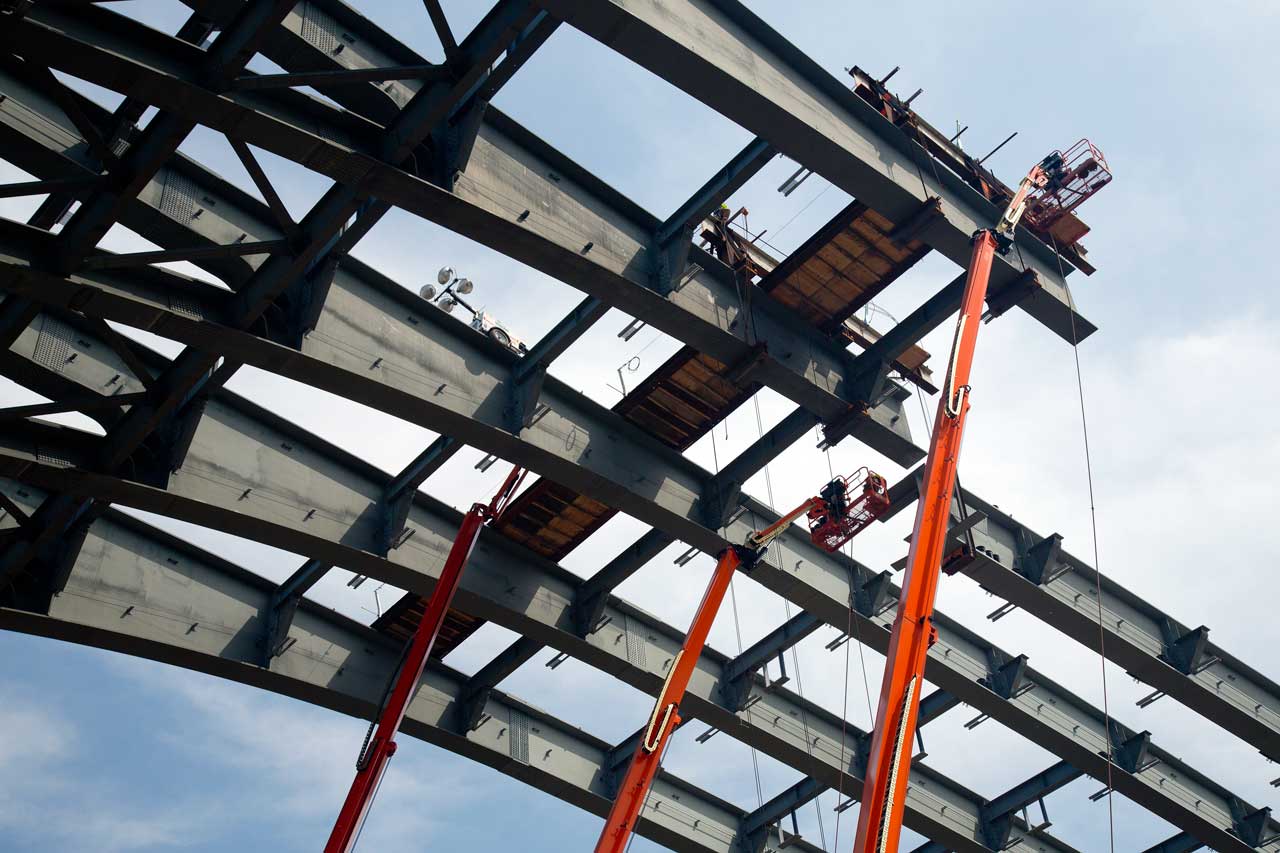


One of the things I love about construction photography is the opportunity for finding abstract shapes and patterns within the steel and concrete.  Combine this with the high contrast light you have from a low angle sun and some powerful images can be created. 

Below, the Cleveland Rowing Club is seen passing by Pier #4 in April of this year.


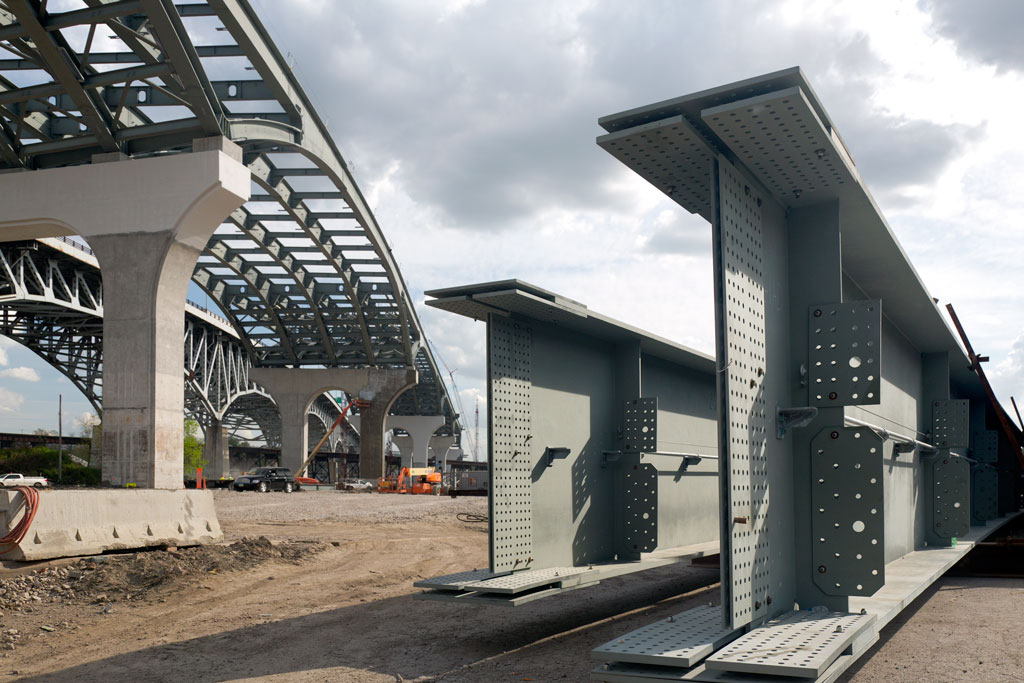
The photo below shows a number of floor beams resting near Pier #3.  These weigh about 1,500 Lbs each and mount at  right angles to the much longer 100,000 lb steel beams.


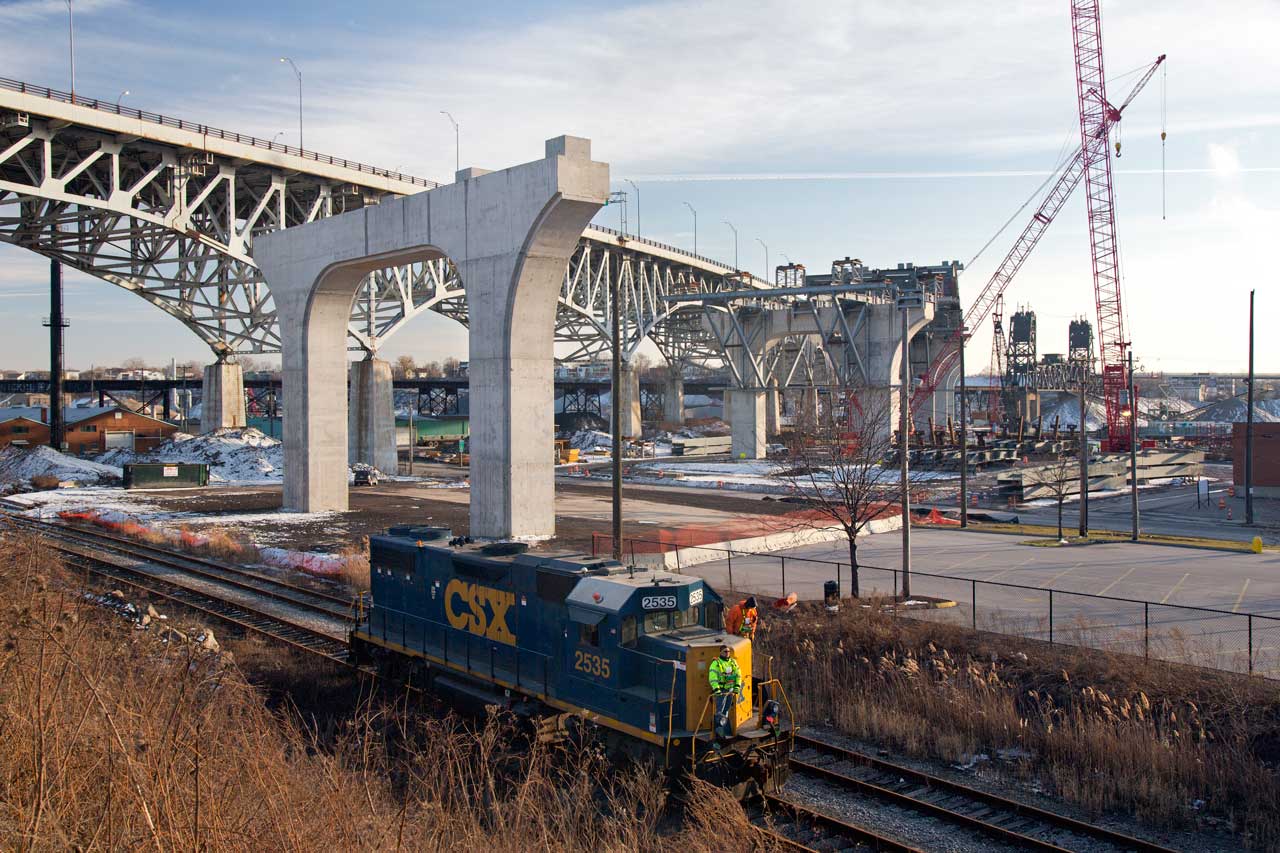
Work also continues on the east end of the bridge as it crosses over W. 3rd St. in the flats.  This shot was taken on March 3 as a CSX engine was moving to another siding.


March 28, 2013 - The shot above shows the left pillar of Pier #9 as well as Piers 8 - 5 as they recede off to the west.


The two photos above show Pier #11 which is the widest of these structures.  The new Ontario St. ramp merges with the bridge deck at this point so it is necessary for this pier to be large enough to accommodate both roadbeds.

The author stands at the end of Pier #11 on the east bank as it overlooks the Flats valley.

Sunday, April 1, 2012

Fog On The Cuyahoga - Atmospheric Perspective


© Stuart Pearl 2012 - Click on Images to Enlarge

We get all kinds of weather in Cleveland.  "Lake Effect" can randomly dump snow, deliver rain, and cause fog when least expected.  All this happens downtown and across both eastern and west suburbs.  But the Flats Valley creates it's own atmospheric effects. 


Cold lake water, a warmer river current and Spring showers can create some interesting photo opportunities.  Above, the 620' bulk carrier Mississagi heads out to the lake under a light rain and fog.


Tied up along Columbus Road is the 110' Apalachee.  Built in 1943 she is now a retired U.S. Coast Guard Cutter and one day will become a floating museum.  During her life she performed search and rescue, fire fighting, law enforcement and ice breaking duties on the Great Lakes.  A video of the Apalachee arriving in Cleveland on May 29, 2009 can be seen on Jeff Thoreson's blog here.

I've always tried to imbue my images with a sense of depth.  I want the viewer to feel that the near portions of a landscape are rising up to meet the eye while the far objects are receding into the distance.  This creates the feeling of dimensionality. 

I'm not attempting 3-D or stereoscopic photography. I'm just trying to create a visual experience that goes beyond the flat print hanging on the wall or being viewed on a computer monitor.


The great landscape painters faced a similar challenge long before photography was invented.  How could they represent the real world which has height, width and depth, on a flat two dimensional canvas?  They used a concept we refer to as atmospheric perspective. 

When we gaze out over a landscape, the closer foreground objects are more colorful, sharper in detail and have greater contrast.  Things in the distance are less distinct, fuzzier and the atmosphere may even look hazier.  Our brain and eyes then assemble this information into the three demensional vision of the world we see.

A walk along the Cuyahoga on a foggy day provides great opportunities for this type of photography.  Foreground objects are sharp and bold in their solid relief.  The background fades into a muted distance as colors lose their saturation and become indistinct.  Photographic compostions done under the even lighting of a cloudy day can take on a soft painterly aspect.  This can be a wonderful change from the often razor sharp aspect of today's digital photography.  There are also processing techniques in Photoshop that I use to enhance my artistic interpretations of Flats landmarks. 

A major criticism of digital photography is that often the maker creates photos that are too sharp.  They become harsh in their representation of the world.  This can have it's place depending upon the goal and intent of the photographer.  But too apply this as a broad brush to every image is a mistake.  I use the sharpenning technique sparingly - not every object should jump off the photographic canvas.  I still like to have most of my images look like traditional photographics, pleasing to the eye, and relaxing to view.


Concrete River Bank Anchors on the Cuyahoga

I've often told fellow photographers that much can be learned by walking through a museum's landscape galleries, and studying the great works. Albert Bierstadt is one such artist I've admired. He created such beautiful works as Looking Up Yosemite Valley , Rocky Mountains , and The Oregon Trail . The last is one of my favorites. I've viewed it in the permanent collection of the Butler Institute of American art.  Standing a few feet from this magnificent work it's a sight to behold.

Once the fog burns off you can see an interesting view of the Hart Crane Memorial Park on Columbus Road.  It features interesting metal sculpture inspired by Crane's poetry.  Gene Kangas designed this public art.


This last compostion was made during the 2011 Ingenuity Festival, well above the Cuyahoga.  The weather had been clear and sunny that day in constrast to my fog shrouded compositions. 

The streetcar level of the Detroit-Superior Bridge was open to the public as part of the festival.  I felt the "theater lighting" of the subway arches provided nice framing of the Flat's stacks and other bridgespans against the backdrop of a beautiful sunset.  It's here simply because I feel it's a pretty image.

Friday, November 25, 2011

When Sparks Fly - Innerbelt Bridge Project


© Stuart Pearl 2011 - Click on Images to Enlarge

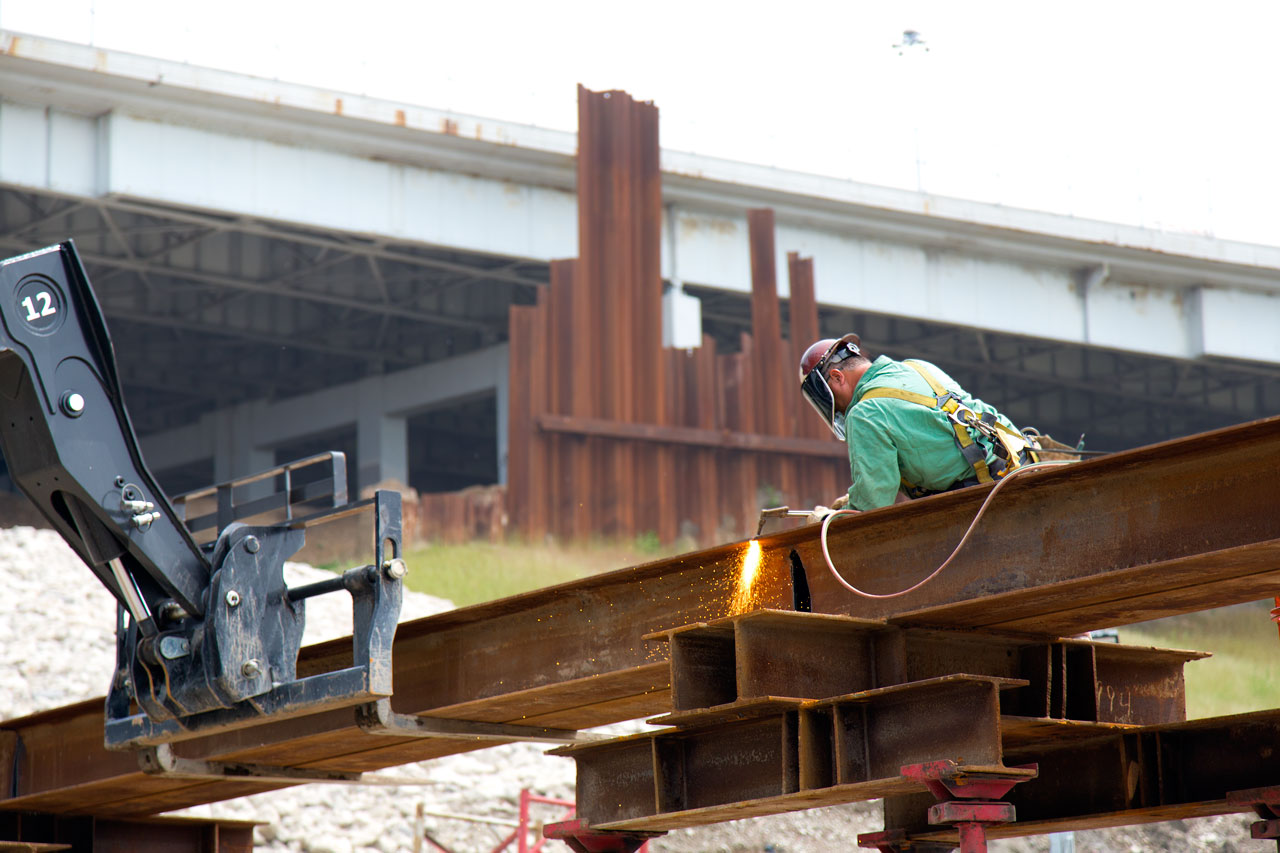
Welders are fascinating to watch. They create their own constellation of stars that appear to swarm like a cloud of angry fireflies. They can cut steel or join beams. It all depends upon the task at hand. 

This steelworker is cutting sheet pile.  Unlike the Super "H" piles which are driven down to bedrock and form the base of the bridge piers on the Innerbelt project, sheet pile is used to hold back earth in areas that may become unstable.


According to the Project Team:  "We use them as a sort of temporary retaining wall when soil conditions or the terrain makes it difficult to dig our traditional excavation for the pile driving and footer construction. Each piece of sheet pile is driven into the soil with the long edge overlapping the previous pile."


Sheet pile stacked near bluffs overlooking Pier 10 construction of Westbound bridge


Here the sheet pile has already been driven into the softer earth at Canal Road.  Steelworkers are cutting them to the desired height.  By contrast, the Super H piles have a much different look.


The super " H " piles used here are the largest ever used for a project of this nature.  When construction is finished, 20 miles of piling will have been used for the new Westbound bridge.

As a kid one of my favorite toys was the "Kenner Girder & Panel Building Set."  It had small plastic pieces just like the "H' piles.  We called them "I" beams and you could assemble a wide variety of bridges and buildings with the kit.

Here a steelworker is grinding the top of an " H " pile.  It has already been driven into the pit that will be the base of Pier #6.  The ends (tops) of these piles must be flat when additional piles are welded onto them.  Each pile will then be a continuous piece measuring approximately 175 - 200' in length all the way down to bedrock.

Above is Pier #9 at W 3rd St. on September 16.  Steelworkers are finishing the rebar work inside the cage atop both legs of the pier. Once the rebar insertion is completed, concrete is pumped into the top cap.  The steel comprising this top cap weighs 217,000lbs.  It will hold 1100 yards of concrete.

In this September 16 photo concrete is being pumped into the top of the leg that will form one side of Pier #8.  The exposed rebar will eventually hook into the "top cap" portion of the structure.

Looking out from the bluffs near the Fireman's Museum you can see a clear view of the bridge piers taking shape in the Flats valley.  Pier #9 at W. 3rd St. still "wears" its top cap insulating blankets in this October 7 photograph.  Those blankets help keep the concrete temperature even as it cools after being poured.  If it gives off heat too quickly it won't cure properly and strength will be lost.

This view from the Hope Memorial bridge shows Piers 9, 8 and 7 in their various stages of construction.  Nine is the furthest along, and you can see the "H" piles being driven for the base of Pier seven at the far right.


A forest of " H " piles seems to rise from the site of the old Marathon gas station adjacent to the fireman's museum.  As each pile is welded to the length before it, the pile driver hammers it down towards bedrock.  At this location that point is 200 - 225" deep.

Standing at the site while the pile driver is working is quite an experience.  Without earplugs the sound is unbearable.  Fortunately I keep some in the car for this purpose.  At a distance of 50' you can feel the earth reverberating up your entire torso with every strike. 


Measurements are marked off on the " H " piles so the steelworkers know how far each has been driven into the ground.


The insulation jackets have been removed from Pier 9 in this October 28 picture.  The concrete has cured sufficiently to allow removal of the side forms comprising the top cap.  Only the center piece remains.


November 4, 2011 - Both legs and the center top cap of Pier 9 are now fully visible. This is the first major above ground structure of the West bound bridge to be nearly complete. Small decorative indentations called "reveals" can be seen at the top of the pier.
Artist's conception of completed bridge - Photo Courtesy of the Innerbelt Project Team

The five cantilever beams that will support the roadbed will line up with these marks. This new I-90 deck will be banked at this point; the engineers call it Super Elevation. The square structures atop the pier that vary in height will help achieve this.


Driving along Canal Road you can see what 50+ years of weather have done to the piers of the current Innerbelt bridge.


The Lorain Carnegie Bridge (Hope Memorial) lands on the east bank quite close to where the new West bound bridge will touch down.  Here the early morning light is washing across its white columns.

Rebar is critical for adding strength to the poured concrete.  Much of it is assembled on the concrete pier pads and in the legs.  But a lot of it is also "woven" on the ground prior to insertion in the forms.  The steelworkers can work with the rebar anywhere.  But having room to work on the ground is safer and much faster in some instances. 


After the necessary rebar patterns have been assembled on their frames, cranes lift them into place.  The steelworkers then wire them together and attach then to the pier legs. 

This view is from the west bank slope near the former site of Cleveland Cold Storage.  It was taken on November 21.  Just left of center you can see the two legs that will comprise Pier #5.  The Norfolk & Southern rail trestle is at the left.


Welding continues everywhere within the project. On the West bank not far from the University Inn, workmen are reinforcing the river bulkheads with a variant of sheet pile.

This slope had been a problem over the years. Not only did it push against the bulkheads, but it placed pressure on the piers of the current Innerbelt bridge.  Here they are using a type of crane mounted vibrating pile driver.


I watched in fascination as the McKee Sons bulk carrier was pulled backwards by a river tug. Two welders did their work as the bow swung closer and closer to their scaffolding.

I don't know if they were aware how close the freighter passed.  From where I stood it appeared not more than 25 feet.

The current Innerbelt bridge will remain standing for a couple more years.  Traffic will be moved to the new Westbound bridge once that new structure is completed in the Fall of 2013.  But walking amongst its old concrete piers still affords interesting views of the Flats.

* My thanks and appreciation to the Innerbelt Bridge Project Team for providing much of the technical information found in these articles.