Friday, October 21, 2011

Indiana Road Trip - Halloween Time

© Stuart Pearl 2011 - Click on Images to Enlarge

Weekend road trips are nice. They break up the regular routine, give you a fresh prospective on new places, and provide an opportunity to meet new people.

This past Fall Jeanne and I travelled to Bloomington, Indiana where our daughter and husband live. Bloomington is a wonderful college "town." It has interesting architecture, great restaurants around their town square and is surrounded by beautiful green spaces.

We knew Jennifer had married into a wonderful extended family after we met them at the wedding. They live in Bedford which is a rural community just outside of Bloomington. We really didn't appreciate how nice they were until we were invited to their home for dinner, and then some olympic pumpkin carving.

And we are talking about some serious gourd surgery. They had set up tables in the middle of the garage across from their ATV's, covered everything in newspaper, handed out the knives, and then the seeds started flying.


Indiana University is surrounded by beautiful woodlands.  Some of their cross country tracks run through these areas.


Another wonderful place to visit in the area is Nashville, Indiana.  Some people refer to it as an historic Hoosier artists colony.  Others call it a tourist trap.  Either way, it does have interesting art and craftwork for sale and on display.

<>
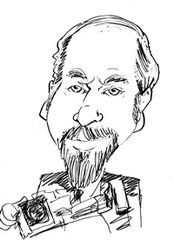
Self Portrait in garden "gazing ball."


If Jeanne and I are in a shopping mood we may stop at the Lodi, Ohio outlet mall on the trip back to Cleveland.  The place is literally out in the middle of corn fields.

 This poor farmer waited a bit too long for his wife to finish shopping.

Wednesday, October 5, 2011

Fire Balls Outside My Window

© Stuart Pearl 2011 - Click on Images to Enlarge

I don't often see fireballs outside my window in downtown Cleveland. And this went on for a couple of weeks. Parts of Cleveland's E. 9th St seemed to get blown up on schedule each day. But there were no sirens or ambulances.

Marvel Comics had come to town, and Hollywood was filming the new Avengers movie. For a little over a month parts of New York's 42nd street had been recreated just down the street from the Rock And Roll Hall of Fame.
All of this was going on about four blocks from my office window. We are not talking about the old British spy series with Mr. Steed and Mrs. Peel. This action involved Captain America, Thor, Ironman, Nick Fury and a host of bad guys.

Back in August movie trailers, crains and traffic barricades began showing up on E 9th St. These were accompanied by flatbed trucks delivering shot up NYC cabs and other damaged vehicles. Fake New York City storefronts were also placed in front of Cleveland shops, and wrecked "movie" masonry was hoisted into place.


It was pretty easy to walk by the set during setup. You could see explosive devices being rigged to flip cars and other tricks of the trade. At the same time, awnings were being installed on some store fronts to give them a "New York" look. Parts of that block never looked better.


Ivan Schwarz, Executive Director of the Greater Cleveland Film Commission was seen on the set at this time.


Small cranes and tow motors moved up and down the street daily arranging "wreckage" and movie props according to the script.

The action was about 1500+ feet from my 14th floor window, and actual details were hard to see. Rather than get a stiff arm holding by holding my camera and long lens, I mounted everything on a tripod and aimed it at the set. I also installed a remote release near my desk so I could quickly fire off a few shots if I saw action being filmed.

Usually I wasn't quick enough to capture the start of a sequence. But speeding police cars and bright camera lights were an indicator that something was about to happen. I'd start shooting at those moments. Here you can see giant diffusers lighting a scene being flooded with "move smoke" as extra's ran about.


The local National Guard was actually called in to play a role and arrived with full kit and vehicles.


Explosions were fast and without warning. Employees in the Medical Mutual building overlooking the set would typically hear a countdown prior to the blast, but there was no warning sound at my distance. The fireballs would appear and disipate in a matter of seconds. Observers said the explosions were just loud "whooshes." Convincing sound would be added later.


How much of E. 9th street will avoid the cutting room floor? We'll just have to wait until the movie debuts next summer to see how much of Cleveland survives, even if it was made to look like New York's 42nd street.

Saturday, August 13, 2011

Construction Up Close at the Innerbelt Bridge

© Stuart Pearl 2011 - Click on Images to Enlarge

Think of multi-ton jello molds. But substitute concrete for the jello, and use steel rebar in place of ground carrots. These yellow forms will be used for the curved part of the Innerbelt Bridge piers forming the "caps" beneath the roadway.

Once the workers finish assembling the sections, they will be hoisted into place around the rebar being held in place by the concrete pier base. Concrete will then be pumped into the double wall structure and form a hollow pier.

"The piers are hollow. The base is solid concrete, but forming the piers that way would add unnecessary weight and cost." This is what the Project Team explained to me.

The myriad strands of embedded rebar give the pier added strength. A concrete release spray is applied to the inside of the forms. It is similar in function to non-stick cooking "Pam". Once the concrete has dried it will allow the forms to be more easily removed.


Rebar rods stacked and ready for installation

I was a blueberry for this photo trip. Blueberries are site personnel who are with blue hardhats. The color means the person has been on the job site for less than 90 days. We are the newbies. I noticed I was surrounded by "white hats." These are the experienced workers and have been on the job site longer than three months.

Pier 9 - 7/29/201.

There are approximately 200-300 workers on the Innerbelt Bridge project each day. They keep a wary eye on the blueberries.

"Here are your safety glasses, put on this safety vest and always watch the ground wherever you step. The earth may be unstable. There are rocks, pieces of metal and construction equipment everywhere. Keep an eye overhead also." These were my instructions for the day.


Concrete forms with anti-stick coating ready for assembly

I was now street legal on the Innerbelt construction site, closely supervised by the Project Team for this tour. Previously my images had been limited to the sidewalk sidelines.


Iron workers installing rebar on Pier 9.

Wanting to legally and safely get closer to the action, I contacted the Project Team. They granted me supervised access, provided me with the proper safety gear, and answered my questions.


These workers are expelling water from the cooling pipes which are embedded in the concrete pads. The pipes had been threaded through the rebar prior to the concrete pour.

Once the water has been removed, the pipes will be filled with grout that will harden. In this way there will be no moisture to expand and crack the pier during the cold winter months.

Cooling pipes embedded in concrete and rebar.


When concrete dries it generates heat which is completely normal. However it can sometimes reach temperatures that are 20F - 50F degrees higher than the ambient. If the heat builds up too fast, the concrete will not cure properly and it can crack.

The huge amounts of concrete poured into each pad generate a great deal of heat. To complicate matters, the center of the pads get hotter than the edges. Cool water is pumped through these pipes to compensate for this build up. This helps reduce the center temperature, bringing it closer to that at the edge. Insulating bags are also wrapped around the edges to help equalize the cooling temperature.

"H" piles near Pier 5 ready for installation - 7/29/2011


Pier 5 piles - 7/29/2011

This is why contractors recommend that you water your concrete for about a week after you've had a new driveway poured. The amount of concrete is less but the principle is the same. Your driveway will last longer and be less likely to crack.
Pier 5 piles near Norfolk & Southern railroad bridge.

It was an eerie sensation, "feeling" the H piles being hammered into the ground. I was standing on an embankment about 150' from the Pier #10 site. Each time the pile driver struck the 60' six ton "H" pile, the ground vibrated up against the bottoms of my feet.

The sound was almost deafening as it echoed off the old innerbelt bridge. With each strike the pile dropped several more inches into the ground.

When the pile moves less than one inch after 20 strikes, the operator knows he has hit bedrock and stops the pile driver. The Walsh crane driving the piles is so heavy that large timbers are laid over the ground to keep the earth from becoming too compressed. The counterweights alone weigh 118,000 lbs.

Site of Cleveland Cold Storage - 7/29/2011


Here you can see the center piece of the pier cap that will top Pier 9. The darker non-stick coating is visible on the curve. This will help in its removal after the concrete has dried.

The center and two sides of the cap will weigh 217,000 lbs when fully assembled. A single crane will lift each component separately, and the iron workers will bolt them together once they are atop the piers.


Pier 9 with tops beginning to flare - 8/12/2007

The assembled pier cap will be filled with 1100 cubic yards of concrete. It will take approximately 110 truck loads of concrete to complete that section. By comparison the footings use about 640 cubic yards.

Artist's conception of completed bridge span - photo courtesy of Innerbelt Bridge Project.

Panorama of Flats valley, W. 3rd St. at center - click to enalarge.

Saturday, August 6, 2011

Dinosaurs in the Mist

© Stuart Pearl 2011 - Click on Images to Enlarge

It was like a misty prehistoric forest. Steel heads rose and fell, biting into chunks of concrete and rebar as rain covered their bodies. The high velocity spray was like a cascade from some primordial waterfall.

July 19, 2011

Cleveland Cold Storage sat here for more than 75 years. Now only mechanical jaws foraged in the rubble strewn landscape, roaming the mounds of the old building, picking at its carcass.


The ground will have to be cleared and stabilized before bridge construction reaches this land. The near slope has been one of the problem areas over the years, putting pressure on the river bulkheads.

In the past lateral ground pressure had slightly shifted the expansion joints on the current Innerbelt bridge. This required complicated repairs. Regrading the slope down to the river will avoid these conditions in the future.

July 19, 2011

In my July 17 blog I had images of wrecking machinery that resembled the carnivorous dinosaurs of millenia past. These pictures show the less aggressive creatures, browsing through the fields of smashed concrete and steel.

Carefully picking their way through the concrete they will separate stone from steel, the separate materials to be recycled into some other project.


July 19, 2011

7/1/2011
7/1/2011

The completed bridge piers of the new structure will be stained white. This will present a bright canvas for aesthetic lighting that will highlight the bridge architecture. That will likely begin in the fall of 2013 when the (first) westbound bridge is completed with its 5 lanes.


July 19 - Workers continue to install the rebar reinforcing rods at W. 3rd St. on what will become bridge pier #9. Above this section the cement forms will be installed for the curved portion of the pier that will flair out to hold the roadway.

Decorative grooves have been imprinted into the concrete as part of the design work for each pier.

August 5, 2011

Several months into the project the path of the new Westbound bridge is becoming apparent as it crosses the Flats valley. This view from Canal Road shows the "H" Piers that will form the foundation of bride Pier #10. These will be pounded into the ground until bedrock is reached. The current Innerbelt bridge is to the left. The Lorain-Carnegie (Hope Memorial) bridge can be seen on the right.

With the Nortfolk & Southern Railway trestle in the distance, Pier #9 is changing shape as the curved cement forms are being attached.

August 5, 2011


The forms are coated with a special material to allow easier removal once the cement has dried.

A forest of "H" beams rises from location of what will be bridge Pier #10 just below and west of Canal Road. The two eastern most Guardians of Transportation can be seen flanking the Hope Memorial Bridge in the background.

7/29/2011

The former site of Cleveland Cold Storage seems nearly picked clean by the excavation team.


The basement foundation walls can now be clearly seen. These will have to be completely removed and the ground stabilized in preparation for the westbound bridge supports.

The diggers cruise the edge of Tremont, removing the last portion of Cold Storage.

Just West of the University Inn and adjacent to the W.14th St. Innerbelt ramp sits the Greek Orthodox Church of Annunciation. It's beautiful golden domes illuminate the landscape even on cloudy days.

The excavators have begun stabilizing the hillside on the west bank just below Tremont. When the new Eastbound bridge is completed in 2016 it will land near this area.

Tremonts unique neighborhood displays much decorative character. Sometimes you will find simple artistic expression attached to a yard fence.

For comprehensive viewing, all of my Innerbelt Construction images can be seen HERE.